Ove’s suicidal crisis
A Man Called OveOve’s suicidal crisis is a recurring response to bereavement, unemployment, and the collapse of the routines by which he has understood his life. His preparations are meticulous, but the attempts do not proceed as planned: a rope fails, an emergency at a railway platform redirects his attention, and the presence of The Cat finally gives him a reason to turn off Ove’s Saab. The pattern makes his wish to die inseparable from the responsibilities and attachments that keep drawing him back into the lives of others.
Loss, work, and preparation
After Sonja’s funeral, Ove does not immediately stop working. She dies on a Friday, is buried on Sunday, and he returns to work on Monday because, in his view, that is how a person handles things. Six months later, managers arrive to tell him that they had delayed delivering the news of his impending loss of work so as not to spoil his weekend. The sequence places bereavement beside a second rupture: the work that had given shape to his days is taken away just as he has tried to carry on by routine. The following Tuesday he is oiling the kitchen worktops, a small domestic task amid a life in which he can no longer see a purpose for himself.
Ove treats his first preparations as a final set of practical obligations. He pays the undertakers and arranges to be buried next to Sonja in the churchyard. He calls the lawyers and leaves a letter in an envelope with receipts, the house deeds, and Ove’s Saab service history. He pays his bills, checks that he has no loans or debts, washes his coffee cup, and cancels the newspaper. The completeness of this inventory is significant: even as he plans his own death, he wants to spare others the work of settling his affairs. The same orderly responsibility that once supported his ordinary life now organizes his exit.
The failed hanging attempt
For his first attempt, Ove puts on his best trousers and going-out shirt and protects the floors with plastic. His concern is not simply for the house as it is; he imagines real-estate agents entering before the ambulance workers have removed him and wants to prevent their shoes from marking the floor. The stool he uses carries its own domestic history. Sonja had wanted a different color in one room every six months; after Ove objected and she obtained a decorator’s estimate, he went to fetch the painting stool. It has been painted over repeatedly, a household object repurposed for an act she would never have wanted.
After installing a hook in the living room ceiling, Ove puts on his jacket and checks for the envelope. He turns out the lights, takes a rope from the clothes-dryer, and pauses to touch Sonja’s coats before going to the living room. The attempt fails when the rope breaks. Ove is left on the floor looking at the hook and then directs his anger at the poor quality of modern manufacturing. He gets up, brushes himself down, and looks around the ground floor, his face hot with feelings he cannot distinguish between anger and shame. The failure does not resolve his grief; it returns him to the house and to the material world he had tried to arrange so carefully.
Repeated plans and interruptions
Ove later spends much of a night comparing possible ways to die, even drawing diagrams and charts. In the morning, after clearing snow from the path between his house and shed, he decides on another plan. He follows his routines first: he puts away the shovel, dresses in his good suit, eats breakfast, listens to the radio, washes up, wipes the counter, checks the radiators, switches off the lights, and makes sure the coffee percolator is unplugged. He also checks Ove’s Saab and its tires, then rereads his instructions about the summer tires and the rim bolts. His attention to such details gives the plan the form of an ordinary task list, while exposing how difficult it is for him to stop thinking as a caretaker of objects and obligations.
In the garage, Ove arranges for exhaust from the car to enter through a tube and sits inside. His thoughts return to the life he and Sonja had agreed to share, and to his belief that he should have been the one to die first. He worries that unemployment has made him a man without a purpose, no longer someone Sonja can rely on to take responsibility or fix things. A banging at the garage door intrudes, though in this moment he ignores it. The scene links his plan not only to missing Sonja but to a threatened identity: he measures himself by the ability to work, maintain, and provide practical help.
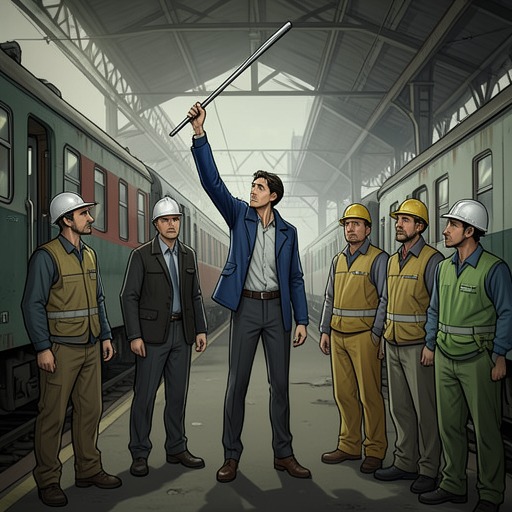
At the railway platform, Ove has chosen a train as the means of ending his life and watches its approach while carefully considering the timing. Before he can act, a man in a gray suit loses consciousness and falls onto the tracks. The crisis shifts outward, from Ove’s private plan to the immediate danger facing a stranger. The scene establishes a recurring interruption in his suicidal thinking: when another person needs help, attention and action displace the carefully prepared intention.
Attachment as interruption
The Cat becomes a more intimate interruption. In a later scene, Ove backs Ove’s Saab into the garage, leaves the engine running, and considers waiting there with The Cat. He misses Sonja so intensely that continuing to live feels unbearable, yet he looks at the cat and turns off the engine. The decisive gesture is small and practical. He does not explain away his grief; he stops an action that would also end the cat’s life.
A further passage brings the same conflict into the house. The Cat howls outside while Ove thinks about Sonja and the life they had promised to share. He insists to himself that his wish to die is not simply a matter of giving up: he does not know how to go on without the physical closeness of the woman he married. He lays pills out beside the washbasin, but the cat’s cries are interrupted by a dog barking. The passage again places his preparations beside sounds and relationships beyond his control, without presenting grief as suddenly cured.
Narrative significance
The crisis recurs through different settings—the carefully protected living room, the garage, and the railway platform—but Ove’s habits persist across them. He makes lists, checks equipment, protects floors, and attends to practical consequences even while rejecting the future. This contrast gives the episodes their particular force: his capacity for responsibility has not vanished, though he has come to believe there is no one and nothing left for him to serve.
The interruptions do not cancel Sonja’s death or make Ove’s sorrow simple. Instead, they reveal the continuing claims on him: a stranger in danger, a dependent animal, and the unfinished business of ordinary life. At first, Ove prepares to leave without burdening anyone; repeatedly, another life or responsibility complicates that plan. The crisis therefore marks both the depth of his bereavement and the gradual return of connection, not through a single declaration or cure, but through actions that keep him present.